
Mary Garrett Hay
By Kathryn S. Gardiner
Originally published May 8, 2020
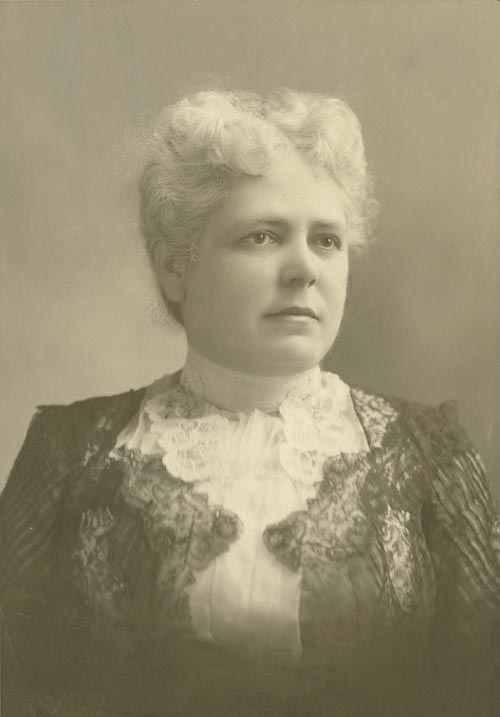
Hoosier-born Mary Garrett Hay, often called Mollie, was born to politics in 1857. After the early death of her mother, Mary would travel with her father from their Charleston, Ind. home on his medical or political visits. Along with being a physician, her father was an important Republican, and those childhood experiences sparked a political zeal that would endure throughout her life.
Public Domain
At age 16, Mary studied to be a pharmacist at the Western Female Seminary and then briefly worked at her father’s pharmacy before she engaged fully in political advocacy, with a focus on temperance and women’s suffrage. Though the exact year is unknown, it was through these pursuits that she met lifelong friend Carrie Chapman Catt, founder of the League of Women Voters. The two would become inseparable, moving in together for a short period of time during the summer of 1895. After the death of Carrie’s husband in 1905, their co-habitation became permanent, with Mary taking over many of the responsibilities of caring for the household.
Together, the women were a formidable force for suffrage, as well as temperance. They spent most of 1899 traveling the states and attending conventions to advocate for their causes. In the decades that followed, they each became vital members—and often leaders—of organizations such as the National American Woman Suffrage Association, New York Equal Suffrage League, Women Suffrage Party, and Women’s City Club of New York. Mary served as president of The Daughters of Indiana in 1912 and was also the president of the New York City League of Women Voters from 1918 to 1923.
Of these times, history recorded more of Carrie’s speeches than Mary’s, and she is the more recognized of the two (Angelica Houston portrayed her in the film Iron Jawed Angels.) Carrie notably supported a resolution distancing the NAWSA from then-president Elizabeth Cady Stanton’s book, The Woman’s Bible, and was elected to the presidential position after her. During Carrie’s tenure, the NAWSA successfully won the support of the United States House and Senate for the ratification of the 19th Amendment.
Mary, however, was not inactive. As the chair of the Republican Women’s National Executive Committee in 1919 and 1920, she ensured the issue of suffrage remained top of the organization’s priorities, encouraging women to join the party and registering them to vote.
In 1920, when at last women could participate in elections, Mary and Carrie cast their presidential votes together.
Mary died only a few years later, in 1928 at the age of 71 at the home she shared with Carrie. It was Carrie who found her, arranged her burial, and had a monument to her placed in the Woodlawn Cemetery at her grave. Applying modern terminology to individuals from the past, when the personal details and preferences cannot be known, is questionable practice. What can be said, however, is that many present-day queer advocates see familiarity in Mary and Carrie’s devotion to one another.
When she died in 1947, Carrie was buried next to Mary. Their shared headstone reads, “Here lie two, united in friendship for 38 years through constant service to a great cause.”
 Kathryn S. Gardiner